The Key Moment for Embodied Intelligence
The embodied intelligence industry is at a critical turning point for explosive growth. On March 27, during the “2026 Zhongguancun Forum Annual Meeting” at the “AI Open Source Frontier Forum,” a roundtable discussion titled “The Billion-Dollar Embodied Intelligence Dialogue” became the highlight of the event.
Last year was pivotal for embodied intelligence, with industry output surpassing 10 billion yuan and several companies achieving valuations over 10 billion yuan. Wang He, founder of Galaxy General, moderated the discussion, which included Zhang Peng, co-founder of Zhiyuan Square; Gao Yang, co-founder of Qianxun Intelligent; Tang Wenbin, founder of Yuanli Lingji; and Xi Yue, co-founder of Star Motion Era. They explored four core topics: the current state of industry development, technical bottlenecks, pathways for practical application, and the co-construction of industry standards.
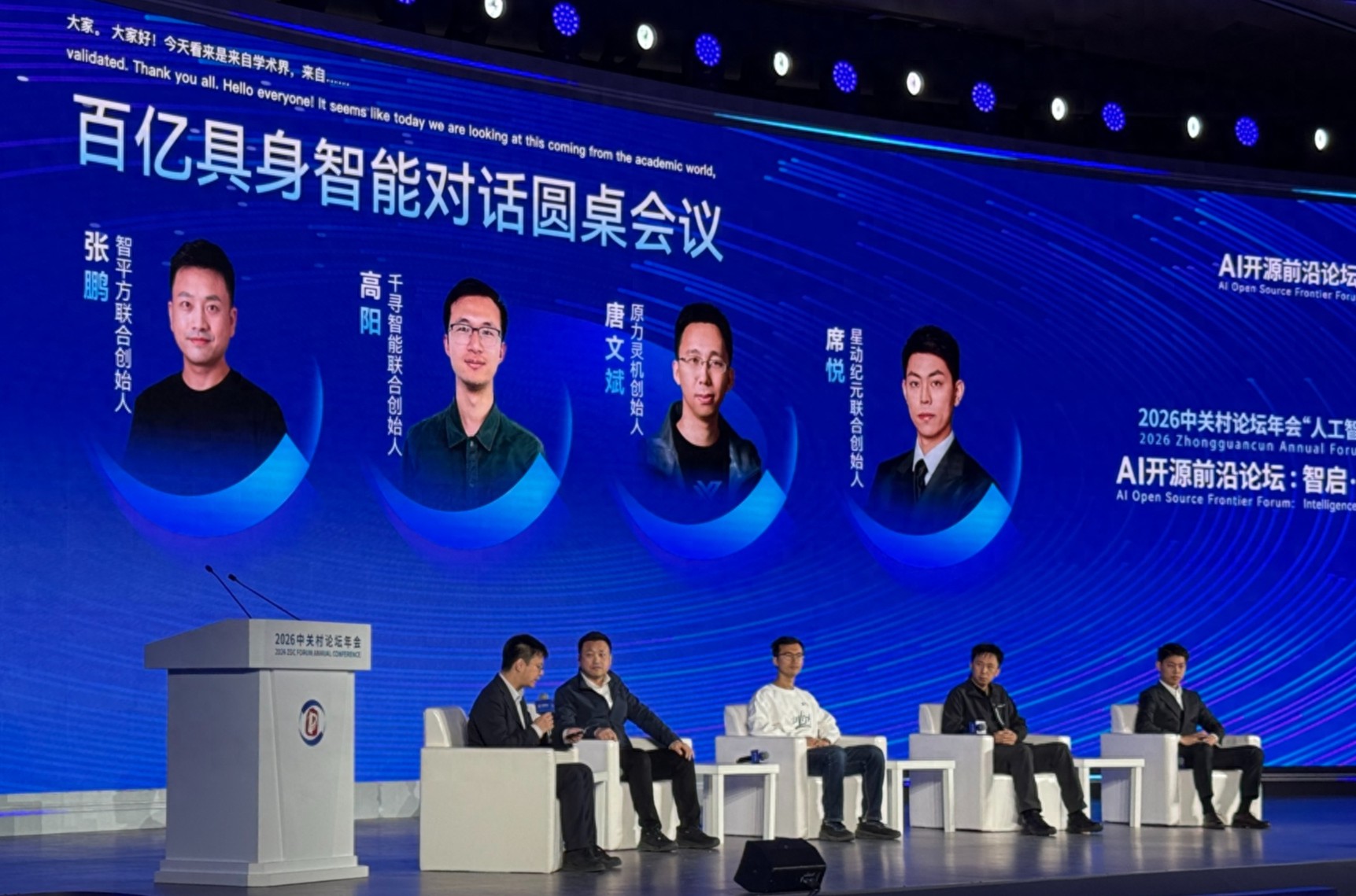
During the dialogue, a consensus emerged: 2025 will be a year for solidifying the foundation and transitioning from the laboratory to real-world applications, while 2026 is expected to mark a leap from technological accumulation to large-scale implementation.
The Anticipated GPT-3.0 Moment for Embodied Intelligence
Reflecting on the past year’s industry developments, the term “foundation building” was repeatedly emphasized by the five guests. Zhang Peng stated, “For the entire industry, the most important aspect in 2025 is to truly validate scenarios and transition from the lab to real-world applications.” He believes that the core scenarios for embodied intelligence have been preliminarily validated, and the next step is to continuously optimize models in specific contexts.
Tang Wenbin noted that the industry’s technical level is still in its early stages but acknowledged the significant accumulation of data, training, and foundational models over the past year, indicating a promising growth trajectory for technological iteration.
The question of when the “ChatGPT moment” for embodied intelligence will arrive remains a hot topic. Gao Yang suggested that in 2025, the industry will be in the GPT-2.0 era. He believes that the development of embodied intelligence follows a similar iterative path as large language models, with 2025 being a crucial transition from GPT-2.0 to GPT-3.0. By then, the industry will have resolved foundational data infrastructure issues and prepared for large-scale expansion.
Currently, embodied intelligence models possess basic generalization capabilities but still exhibit a high error rate, aligning closely with the characteristics of the GPT-2.0 stage. The focus in 2026 will be on large model and large data scaling training, enhancing the system’s scaling capabilities. Gao predicts that the GPT-3.0 moment for embodied intelligence may arrive between late 2026 and mid-2027.
Addressing Core Technical Bottlenecks
The guests also confronted the core technical bottlenecks facing the industry, with data emerging as a central pain point. Xi Yue candidly stated, “The biggest challenge currently lies in the data aspect.” He highlighted the difficulties and costs associated with data collection in real-world scenarios, noting that traditional manual collection methods are no longer suitable for industry needs. Star Motion Era is working on creating a closed-loop data cycle from data collection to model iteration and exploring multimodal data collection methods that combine human input with real machines.
Tang Wenbin added that while data is a core bottleneck, it is not the only issue. Although there are various sources of data, including remote operation data, simulated data, and real-world feedback, the challenge lies in the model’s weak generalization capabilities for unknown scenarios outside the training distribution. He pointed out the paradox between data collection and model deployment: immature robots cannot be deployed in bulk, and without bulk deployment, real-world data feedback cannot be obtained. “We must find a way to enable robots to be used continuously in real scenarios to complete the data feedback process,” he stated.
Zhang Peng also shared his thoughts on solving data issues, suggesting that while open-source data and various internet video data can serve as foundational materials for model pre-training, the most irreplaceable value comes from real-world data feedback in industrial and public service scenarios, which is the industry’s core asset. He recommended building an efficient data cycle to promote continuous data feedback while ensuring data security and sharing with clients, and utilizing synthetic generation, data augmentation, and simulation technologies to amplify data value.
Structured Scenarios for Scalable Implementation
After laying the foundation, the guests reached a consensus on the target directions for 2026. They agreed that the current deployment of humanoid robots must focus on structured and semi-structured scenarios. Zhang Peng indicated that Zhiyuan Square will primarily focus on industrial and public service scenarios in 2026, as these semi-structured scenarios align with current model capabilities and supply chain abilities, allowing for scalable delivery and layout.
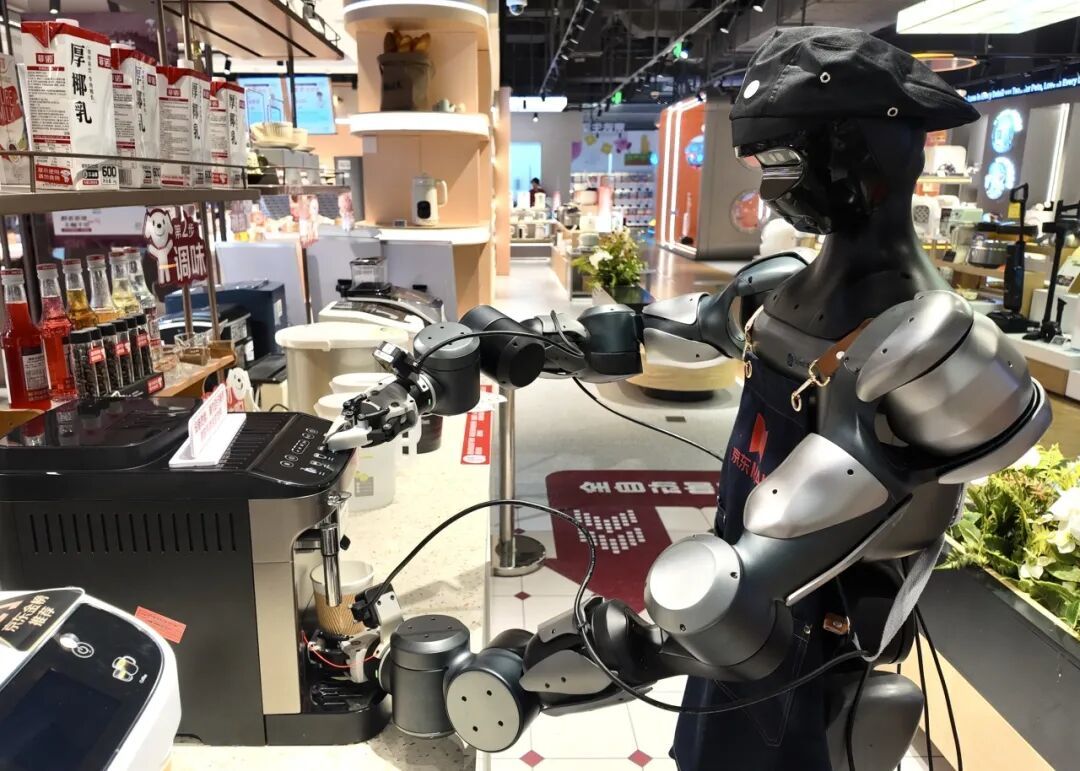
In late 2025, Qianxun Intelligent’s “Xiao Mo” robot was deployed in the Ningde Times Zhongzhou base battery production line, handling high-voltage testing tasks. Simultaneously, the “Moz” robot entered the JD retail scenario, providing product explanations, operation demonstrations, and coffee-making services, completing retail scenario validation.
This deployment strategy is similar to that of Galaxy General. In June 2025, Ningde Times led an 11 billion yuan investment in Galaxy General, after which its Galbot robot began full autonomous operations in the Ningde Times battery factory, adapting to complex industrial conditions. On the retail side, the “Galaxy Space Capsule” unmanned retail solution has been implemented in over 100 stores nationwide.
Wang He revealed the latest achievements of the “Galaxy Space Capsule” during the roundtable, stating that the retail scenario has been implemented in dozens of cities and over 100 stores, accumulating 80,000 hours of real scene operational data to support model iteration.
Tang Wenbin also noted that current model-driven robots struggle to achieve a 100% success rate, so scenario selection must meet four conditions: error tolerance, flexible pacing, generalization capability, and support for long-duration operations. Only then can a clear ROI (return on investment) and business loop be established. He identified logistics scenarios as a priority direction, where a fault-tolerant mechanism can ensure successful deployment.
The Need for Standards in Embodied Intelligence
As humanoid robots gradually enter factories, logistics parks, and retail terminals, the industry’s lack of a unified standard system has become increasingly prominent. At the end of the roundtable, Wang He raised the issue of industry standards.
Zhang Peng broke down the establishment of standards into three aspects: first, data standards and data format specifications, which are the foundation for data circulation and collaboration; second, a robot intelligence level and capability assessment system, providing a unified metric for industry technological iteration; and third, supporting laws and regulations to clarify the behavioral boundaries of robots and accident liability. He believes these three standards are core foundations for the industry’s scalable development.
Tang Wenbin emphasized the core value of assessment benchmarks, stating, “I think internal and external standards are both very important. Internally, if we don’t know how to evaluate models during training, how can we measure our progress?”
From the perspective of the industry chain’s development, Gao Yang added the importance of hardware and interface standardization, predicting that future humanoid robots will evolve into complex integrated forms similar to laptops and cars. This requires standardization of components, remote operation interfaces, and communication protocols to achieve refined division of labor in the industry chain, significantly reducing R&D and adaptation costs.
Xi Yue approached the issue from a safety perspective, emphasizing that safety standards are the most urgent and core demand in the current industry. “The standards for embodied intelligence are behavioral standards, and how to constrain and formulate these standards is worth deep consideration,” he stated. He noted that the formulation of safety standards must avoid overly strict rules that stifle industry innovation while firmly maintaining safety baselines, establishing universal safety standards for the entire industry and tailored safety regulations for different application scenarios.
Comments
Discussion is powered by Giscus (GitHub Discussions). Add
repo,repoID,category, andcategoryIDunder[params.comments.giscus]inhugo.tomlusing the values from the Giscus setup tool.